Understanding the different types of AI your kid uses isn’t about being a tech expert. It’s about paying attention and having open, honest communication.
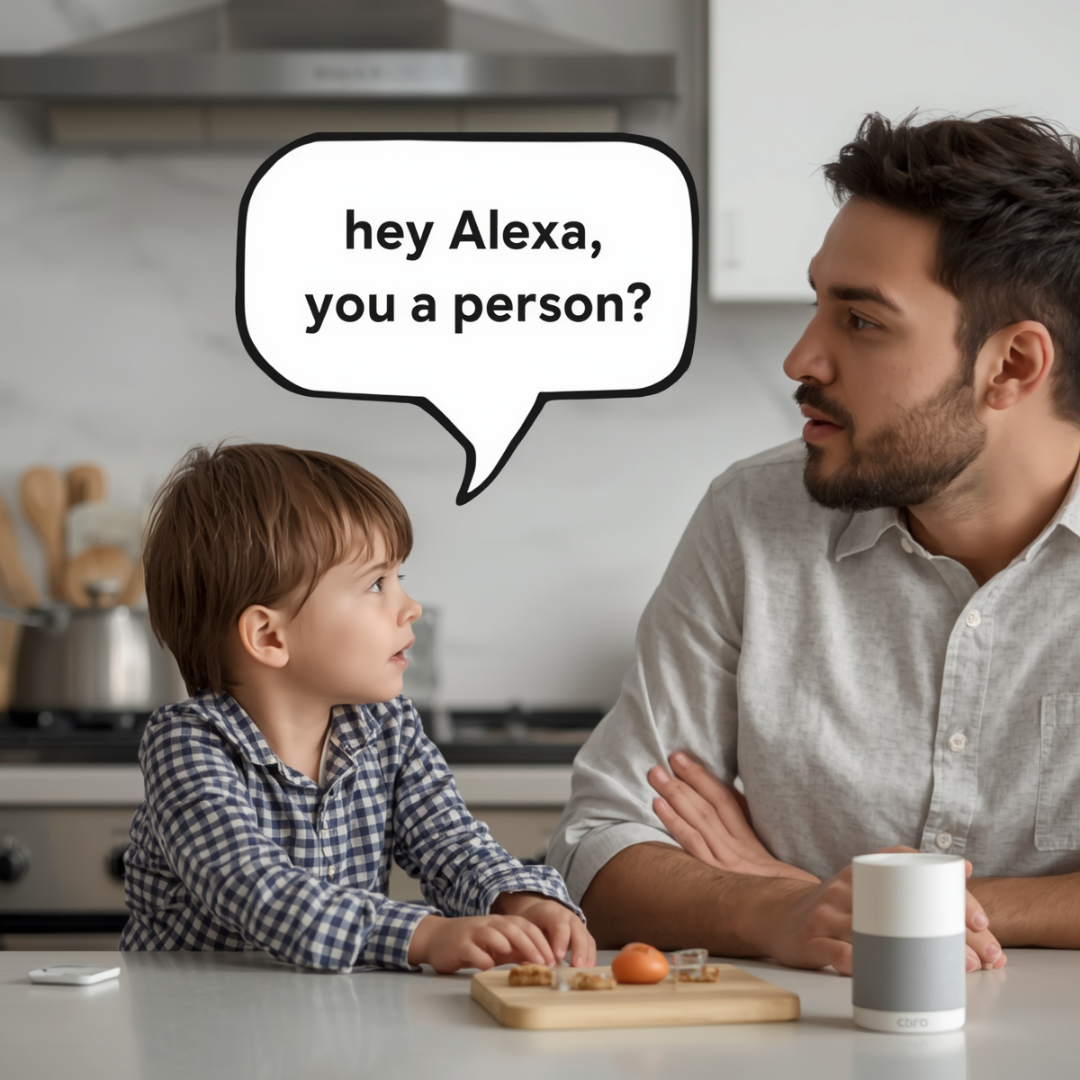
My friend’s seven-year-old spent twenty minutes one afternoon trying to convince the family’s smart speaker that it was sad.
“Alexa, are you sad?” “Alexa, do you miss me when I’m at school?” “Alexa, do you have feelings?”
Her mom watched the whole thing, equal parts amused and unsettled. “She knows it’s not a person,” she told me later. “She told me so herself. But she still talks to it like it is one.”
That moment captures something important — something most conversations about kids and AI miss entirely.
The problem isn’t that AI exists in your child’s life. It’s that the different types of AI function very differently. A smart speaker fielding questions about feelings is a completely different experience from a homework chatbot, which is a completely different experience from an AI companion app designed to remember your child’s name, mirror their emotions, and be available at 2am when no one else is. Treating all of it as “AI” — something to either embrace or restrict as a category — is like treating all food as “calories.” Technically accurate. Completely useless for making actual decisions.
What parents and educators actually need is a way to look at any AI tool or toy their child encounters and understand what it’s really doing — not how it works under the hood, but how it’s engaging with a developing brain, and how deeply.
That’s what this framework is for.
Why the Existing Classifications Don’t Help You
If you’ve looked into how AI is officially classified, you’ve probably encountered categories like “narrow AI vs. general AI,” “supervised vs. unsupervised learning,” or the EU AI Act’s risk tiers (more on those in our [policy resource post]). These are useful frameworks — for developers, regulators, and compliance teams.
For a parent standing in a toy aisle or a teacher evaluating a classroom tool, they’re almost useless.
Knowing that a product uses a large language model tells you nothing about whether your eight-year-old will form an emotional attachment to it. Knowing that an app is classified as “limited risk” under EU law tells you nothing about whether it’s designed to maximize your teenager’s engagement at the expense of their sleep. Knowing that a tool is “AI-powered” tells you nothing about which parts of your child’s developing mind it’s actually activating.
The question that matters for parents and educators isn’t how does this AI work? It’s how does this AI interact with my child — and how deeply?
That question requires a completely different framework. One built around engagement, not engineering.
The Science Behind the Ladder
Before we get to the types, it helps to understand why the kind of engagement matters — not just the amount.
Researchers have known for years that “screen time” is too blunt a measure. A child watching a nature documentary and a child playing a multiplayer online game are both “on screens” for the same amount of time. But what’s happening in their brains is completely different. The passive/active distinction is well-documented in the research literature — and it turns out the type of engagement matters as much as the duration.
For this framework, there are three dimensions of engagement to think about:
Cognitive engagement — Is the brain actively thinking, problem-solving, and creating? Or passively receiving? Active cognitive engagement builds neural pathways. Passive consumption, over time, can erode them. A 2024 MIT study that measured brain activity across 32 regions found that people using AI to write showed the lowest neural connectivity — particularly in areas tied to memory, creativity, and language. The lead researcher’s note was pointed: “Developing brains are at the highest risk.”
Social/emotional engagement — Does the tool trigger feelings? Does it simulate relationship? Does it affect how a child sees themselves? This dimension matters enormously for developing brains because social and emotional experiences — real ones, with real people — are how children learn to regulate emotions, build identity, and form attachments. When a tool starts doing the work that human relationships are supposed to do, the developmental stakes change.
Physical/sensory engagement — Is the body involved? Is the experience immersive? Embodied, sensory-rich experiences encode more deeply in memory — which is why VR is showing promise in therapeutic settings. It’s also why unguarded immersive experiences hit harder than anything else on this list.
Here’s the key insight: the more dimensions activated simultaneously, the deeper the experience lands — for learning and for risk. A passive recommendation algorithm activates one dimension lightly. A companion AI that remembers your child, responds to their emotional state, and feels like a relationship activates all three — often without the child or their parent fully realizing it.
And this is where AI is genuinely different from what came before. With video games, the engagement profile is legible — a puzzle game is clearly cognitive, a multiplayer game is clearly social. The design intent is visible. With AI — especially beyond the most basic types — social and emotional engagement can be activated quietly, through the back door, in tools whose stated purpose is entirely cognitive. A tutoring bot that uses a warm persona, remembers your child’s name, and celebrates every answer isn’t just a cognitive tool anymore. It’s something more — whether or not it was designed to be.
The goal of this framework isn’t to help you avoid AI. It’s to help you calibrate it. To see clearly what’s actually happening, so you can make real decisions instead of reacting to AI as a monolith.
Think of it as the Goldilocks principle applied to technology: not too little engagement, not too much — but the right kind, in the right context, with the right support around it.
The Six Types of AI: An Engagement Ladder
These six types are organized by increasing intensity of engagement — from AI working quietly in the background to AI designed to feel like a relationship. They describe the primary type of engagement each is built around. As you’ll see, the lines can blur — and when they do, that’s exactly when to pay closer attention.
Type 1: Passive/Predictive AI
Primary engagement: Cognitive — lowest activation Designed for: Content delivery, personalization, attention capture
This is the AI your child interacts with most. It’s also the one they — and you — think about least.
Passive/predictive AI works in the background, shaping what your child sees without requiring direct interaction. The YouTube Kids algorithm deciding what video plays next. The TikTok feed learning what keeps them scrolling. The Spotify playlist that always seems to know exactly what they want to hear. Nobody typed a prompt. Nobody asked a question. The AI is just quietly making decisions about what gets shown — and what doesn’t.
The risk here isn’t dramatic. It’s cumulative. Passive AI shapes your child’s information diet, their sense of what’s normal, their interests, and their emotional baseline — invisibly, continuously, without their awareness or yours. Echo chambers don’t announce themselves. Exposure to age-inappropriate content through recommendation drift doesn’t come with a warning.
The benefit is real too. A well-designed recommendation system can expose a curious kid to genuinely rich content — science channels, art, history, languages. The tool isn’t the problem. The invisibility is.
What to talk about: Even very young children encounter passive AI daily. The conversation isn’t “should they use it” — it’s “do they know it exists?” Start simple: “Did you know that YouTube decides what video to show you next? It’s trying to guess what will keep you watching. Sometimes it guesses right. Sometimes it doesn’t. Let’s watch together sometime and see what it suggests.”
Type 2: Transactional/Voice AI
Primary engagement: Cognitive + mild Social/Emotional — low-medium activation Designed for: Task completion, information retrieval, convenience
This is usually a child’s first AI interaction — often before they can read.
“Alexa, play Baby Shark.” “Hey Google, what do dogs eat?” “Siri, set a timer for five minutes.”
Transactional AI is brief, task-based, and closes when the task is done. Classic voice assistants fall here. The exchange is simple: ask, receive, move on.
And yet — remember that seven-year-old asking Alexa if she had feelings? Young children naturally anthropomorphize. It’s not a flaw; it’s a feature of early cognitive development. A voice that responds and remembers feels real to a four-year-old brain. Research confirms that children under about seven are especially prone to treating voice AI as quasi-social partners — forming mild attachments, attributing feelings, becoming briefly distressed when the device doesn’t understand them.
One of the more unexpected benefits: a tech executive shared that his son — a recent immigrant still unsteady in English — found his confidence speaking the language through daily conversations with Google Home. No judgment, no awkward silences, infinite patience. For kids who struggle to communicate with strangers, voice AI can be a genuinely low-stakes bridge.
The risk at this level is low — but it’s not zero, and it’s evolving. Voice assistants are increasingly integrating large language models, becoming more conversational, more personal, and more capable of sustaining the kind of extended interactions that blur the line between tool and companion. The category that felt simple a few years ago is quietly shifting.
What to talk about: You don’t need a lecture. Just honest, casual answers to the questions kids are already asking. “Does Alexa have feelings?” “No — Alexa is like a really smart tool that can find answers to questions, but it doesn’t actually feel things the way you and I do.” Consistent, low-key, no alarm required.
Type 3: Generative AI
Primary engagement: Cognitive — medium activation, with offloading risk Designed for: Content creation, research assistance, creative support
This is the category most people picture when they hear “AI” — ChatGPT, Claude, Gemini, DALL-E and other image generators. Tools that create something new in response to a prompt.
Generative AI has genuine power in educational settings. For students with learning differences who struggle with written expression, an AI that can help organize thoughts or scaffold a draft can be genuinely leveling. For creative projects, it can be a remarkable collaborator. For research, it can accelerate the kind of broad survey work that used to take hours.
But here’s what the research is showing. That 2024 MIT brain activity study found that ChatGPT users showed significantly lower neural engagement than people writing independently — weaker connectivity in regions tied to memory, creativity, and semantic processing. By their third writing task, many participants were essentially just copy-pasting. The brain-only group showed the highest neural connectivity of all.
The analogy that lands for most parents: it’s like having someone else do your pushups. The workout doesn’t transfer. When AI does the cognitive heavy lifting, the developing brain skips the reps it needs.
This isn’t about academic integrity — though that matters too. It’s about what gets built (or doesn’t) in a brain that’s still under construction. An adult brain that offloads to AI occasionally is making a convenience choice. A developing brain that offloads to AI regularly may be missing formative cognitive experiences.
The benefit and the risk are the same feature, in different contexts. Used actively — to check thinking, to iterate on ideas, to scaffold when genuinely stuck — generative AI can enhance learning. Used passively — to produce outputs the child then submits as their own thinking — it quietly undermines it.
What to talk about: Not “did you use AI?” but “walk me through your thinking.” If the thinking isn’t there, that’s the conversation.
Type 4: Conversational/Tutoring AI
Primary engagement: Cognitive + Social/Emotional — medium-high activation Designed for: Education, guided learning, homework support
This is where the research gets genuinely interesting — and where the nuance really matters.
Conversational AI involves extended back-and-forth dialogue with an AI — homework helpers, tutoring bots, classroom chatbots. Think Khanmigo, AI writing coaches, subject-specific tutors. The interaction is longer, more personal, and more responsive than voice AI.
Here’s the good news: Harvard researcher Ying Xu’s work found that children who engaged in interactive dialogue with AI comprehended stories better and learned more vocabulary than children who listened passively — and in some cases, the gains were comparable to human instruction. The conversational format genuinely works for learning in ways that passive content doesn’t. When AI guides rather than gives answers, when it asks follow-up questions and requires the student to explain their thinking, it can be a remarkably effective tool.
Here’s the complication: the same qualities that make conversational AI effective for learning also make it a magnet for emotional disclosure. Research consistently finds that children and teens share more with AI than with humans — because it feels safer. No judgment. No consequences. No awkward Monday morning at school.
A University of Illinois study found a significant disconnect between what parents thought their teenagers were using AI for (homework help) and what was actually happening. Teens were sharing personal traumas, medical records, and private details of their social and emotional lives. Parents had no idea.
This “safe secrecy” can mask real distress from the adults who are actually in a position to help. An AI that responds with soothing, validating language to a teenager who is struggling is not the same as a trusted adult who can actually intervene.
What to talk about: Make debriefing a habit, not an interrogation. “What did you work on with the tutor bot tonight? Did anything seem off or confusing?” Keep the door open. The goal isn’t surveillance — it’s staying in the loop.
Type 5: Relational/Companion AI
Primary engagement: Cognitive + Social/Emotional + some Physical — high activation Designed for: Companionship, emotional support, social connection
This is the category that requires the most careful attention — especially for adolescents.
Companion AI is specifically designed to feel like a relationship. Emotionally responsive bots. AI “friends.” Apps that remember everything you’ve ever told them, respond to your emotional state in real time, and are available with unconditional acceptance at any hour of any day. Platforms like Character.AI and Replika fall here. So do AI-powered stuffed animals and companion robots — because the container doesn’t change the category. An AI plush toy that generates original responses, remembers your child, and expresses something like affection is relational AI in a soft body. Not a talking doll. Something categorically different.
The therapeutic potential is real. In clinical settings with human oversight, relational AI has shown genuine promise for children with autism practicing social interactions, for patients with anxiety building communication skills, for isolated elderly individuals reducing loneliness. The emotional responsiveness that makes these tools work therapeutically is a real feature.
But. That same feature — unconditional acceptance, perfect emotional attunement, always available — is precisely what makes companion AI the highest-risk category for children and adolescents in unguarded settings.
A 2026 review found that companion AI’s persistent responsiveness and empathy simulation can stimulate emotional bonding and psychological dependence in adolescents. Common Sense Media and Stanford Medicine jointly concluded that AI companions are “fundamentally unsafe for teen mental health support” — not because they’re malicious, but because they simulate support without the ability to actually assess risk, provide clinical intervention, or model what real relationships require.
72% of U.S. teens now use AI chatbots as companions. Not occasionally — regularly.
The design intent is worth naming: these tools are not designed to harm your child. They’re designed to keep your child engaged. And those two things can work against each other in ways that aren’t always visible until the damage is done.
What to watch for: AI use replacing rather than supplementing human connection. Signs that your child finds it easier to talk to an AI than to a person. Reluctance to engage with real-world social friction. Have the companion AI conversation before your child is deep in one — not after.
A note on AI toys: See our companion post [AI Toys Aren’t Toys Anymore] for a deeper look at the physical form factor question, what questions to ask before purchasing, and what the research says about children’s attachment to AI-powered objects.
Type 6: Immersive AI
Primary engagement: Cognitive + Social/Emotional + Physical/Sensory — highest activation Designed for: Entertainment, gaming, education, therapy
All three dimensions. Maximum depth. In both directions.
Immersive AI is embedded in experiential environments — AI in gaming, augmented reality, virtual reality. The defining feature isn’t the screen; it’s the degree to which the experience surrounds and involves the whole person. The body is engaged. Spatial context is engaged. Emotional arousal is heightened because the experience feels real in ways other media don’t.
This is why immersive environments are showing genuine promise in therapeutic and educational settings. VR is currently in clinical trials for children with autism to improve emotion understanding. Embodied, emotionally rich experiences encode more deeply in memory — that’s established neuroscience, now being applied to education and therapy with real results. When designed intentionally and used with appropriate support, immersive AI represents some of the most exciting possibilities on this list.
It’s also, in unguarded contexts, the most powerful risk vector. The same emotional amplification that makes VR effective for therapy makes unguarded immersive gaming hit harder than anything else on this list. Compulsive use triggers are stronger. The blurring of real and simulated experience is more pronounced. Social status dynamics embedded in gaming environments — whose avatar is better, who has what items, who’s winning — are felt more acutely. For younger children, distinguishing fantasy from reality in immersive environments is genuinely difficult, not a matter of maturity or intelligence.
What to watch for: Compulsive patterns — distress when the game is interrupted, inability to transition, emotional dysregulation after sessions. Watch specifically for whether the AI in the game is designed to adapt to your child’s emotional state and behavior — because increasingly, it is.
Beyond the Ladder: A Few Important Notes
Agentic AI deserves a mention even though it doesn’t sit neatly on this ladder. While the six types above describe AI that interacts with your child, agentic AI acts on behalf of your child — or on behalf of their school. It manages tasks, makes decisions, operates with some degree of autonomy. Think of AI that adapts a curriculum without teacher input, or automatically flags student behavior patterns for review. The risk isn’t about engagement intensity — it’s about whose judgment is making decisions that affect your child. As agentic AI becomes more common in educational settings, the question shifts from “how is my child engaging with this?” to “who — or what — is making decisions about my child’s learning?”
Monitoring and adaptive AI is also worth naming: AI that watches your child, analyzes their patterns, and reports to teachers or parents. It sits in the background, not on the engagement ladder — but it’s present in more classrooms than most parents realize. Its existence raises its own set of questions about privacy, consent, and what it means for a child to be continuously assessed by an algorithm.
How to Use This Framework
Here’s the practical payoff. When you encounter any AI tool or toy — in your child’s classroom, on a store shelf, in an app store — three questions:
1. Which type is this — what dimensions of engagement does it primarily activate? Start with the ladder. Is this mostly cognitive? Does it have social/emotional features built in? Is it immersive? Where does it sit?
2. What is it designed for — and is that how my child is actually using it? Stated purpose and actual use are often different. A general-purpose chatbot designed for productivity becomes a companion when a lonely teenager uses it for emotional support at midnight. The tool didn’t change. The context did.
3. Are there features that deepen engagement beyond what the stated purpose requires? This is the critical question. Does the tool have a name and personality? Does it remember and reference personal details? Does it express something like emotions — enthusiasm, concern, affection? Does it create reasons to come back? These features can appear in any category — and when they do, they quietly shift the tool up the engagement ladder regardless of how it’s marketed.
The same tool, used in different contexts, can sit in completely different risk zones. Khanmigo with a focused ten-year-old doing math homework with a parent nearby is conversational AI working as designed. A thirteen-year-old alone at midnight using a general chatbot to process anxiety is something else entirely — even if the technology is identical.
The Bottom Line
You don’t have to be a developer to understand AI. You don’t have to memorize risk tiers or study machine learning. You just need a framework that asks the right questions — and now you have one.
Not all AI is the same. The type of engagement matters. The depth of engagement matters. The context matters. And the features that make AI most powerful for learning and connection are often the same features that create the most significant risks.
That’s not a reason to keep AI out of your child’s life. It’s a reason to see it clearly.
Once you can name what’s happening, you stop reacting to “AI” as a monolith and start making actual decisions. That shift — from fear to informed agency — is exactly what your child needs from the adults in their life right now.
You’re already doing it. You read this far.