You’ve probably seen it by now. A school district updates its website. A principal sends home a newsletter. A local news story runs the headline: “[Town Name] Schools Go AI.”
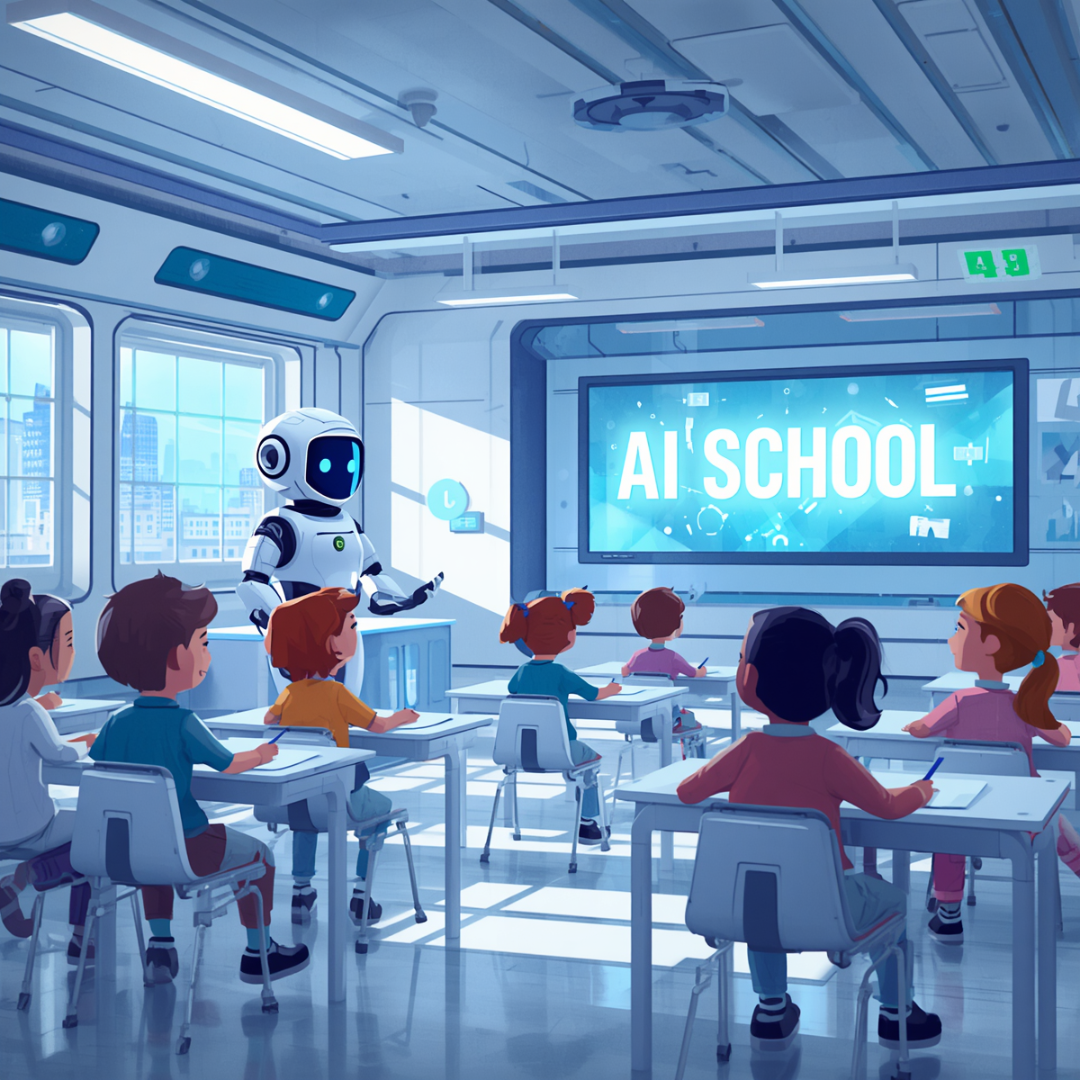
And if you’re a parent, a teacher, or anyone who cares about what’s happening inside classrooms, your brain probably jumped straight to the same image: kids talking to chatbots. AI grading essays. Robots at the front of the room.
That picture — while not entirely fiction — is not what most schools mean when they say they’re using AI in schools.
The reality is both more complicated and, in some ways, more concerning. Because “AI in schools” isn’t one thing. It’s a spectrum. And where a school lands on that spectrum varies wildly — sometimes based on thoughtful planning, sometimes based on budget, and sometimes based on nothing more than wanting to sound current.
Here’s what’s actually going on.
Why Schools Are Rushing to “Do AI” Right Now
Before we get into the what, it helps to understand the why.
Schools are under real pressure to adopt AI — and that pressure is coming from multiple directions at once.
The U.S. Department of Education recently signaled that grant applications emphasizing AI literacy, personalized learning, and ethical AI use will receive priority consideration. For districts that depend on federal funding — which is most of them — that’s not a suggestion. It’s a financial incentive with a very clear message: figure out AI, or miss out.
Then there’s the branding pressure. Schools, like businesses, are susceptible to the pull of relevance. “AI school” has become a badge in some circles, a way of signaling to parents and community members: we’re not behind, we’re forward-thinking. Some districts are leaning into that language hard, even when their actual AI implementation amounts to teachers using a grammar-checking tool.
Here’s the irony worth noting: the business world — which schools often look to as a model for innovation — is quietly walking some of this back. A growing number of companies have discovered that AI tools are expensive to run, inconsistent in quality, and harder to implement well than the pitch decks suggested. The “AI everything” wave is already meeting its first reality check in corporate settings.
Schools are just now riding in.
That context matters, because it means some schools are making decisions about AI in schools based on pressure and perception rather than pedagogy. And that’s exactly why understanding the spectrum is so important.
The Spectrum: What “AI in Schools” Actually Looks Like
Think of AI implementation in schools less like an on/off switch and more like a dial — with very different settings, very different implications, and very different levels of risk and benefit at each position.
Here are the seven ways AI currently shows up in schools.
Level 1: The AI You Don’t Know Is There
What it is: AI embedded invisibly inside tools schools already use.
What it looks like in practice: Your child opens Google Docs to write an essay. A suggestion pops up. Grammarly flags a sentence in their homework submission. The school’s student information system flags a student as “at risk” for attendance issues. None of this is announced. None of it has a brochure. It’s just there.
This is the most widespread and least discussed form of AI in schools — and in many ways, the most important one to understand. Platforms like Google Workspace, Microsoft 365, Canvas, and dozens of other education tools have been quietly integrating AI features for years. When schools adopt these platforms, they’re adopting the AI inside them, whether they realize it or not.
Why it matters: When AI is invisible, accountability is too. Schools may not have evaluated these tools, reviewed their data practices, or even know they’re in use. Students and parents almost certainly don’t.
Level 2: AI as a Teacher’s Assistant (Adults Only)
What it is: Teachers and administrators using AI tools to do their jobs more efficiently — but not in front of students.
What it looks like in practice: A teacher uses ChatGPT to brainstorm a lesson plan on the American Revolution. A counselor uses an AI tool to draft a parent communication email. A principal uses AI to analyze attendance data and identify patterns. Students aren’t involved. Students may not even know.
This is currently the most common intentional AI use in schools, according to RAND’s national research. And honestly? As a starting point, it makes sense. Teachers are overwhelmed. Anything that reduces the administrative burden and frees up mental space for actual teaching has real value.
Why it matters: This level is relatively low-risk for students, but it raises questions about data privacy (what information is being fed into these tools?) and equity (are all teachers getting access and training, or just some?). RAND found that AI training rose from 23% of districts in fall 2023 to 48% in fall 2024 — but low-poverty districts were far ahead of high-poverty ones. The gap is already forming.
Level 3: AI Demonstrated in the Classroom
What it is: Teachers using AI tools in front of students, as part of instruction — but the students aren’t using the tools themselves.
What it looks like in practice: A high school English teacher pulls up an AI writing tool on the projector and shows students how it generates a paragraph from a prompt. Then she asks: What does this do well? What does it miss? What does this tell us about how we read and evaluate writing? The AI is a teaching prop. The thinking is still entirely human.
This approach is thoughtful, intentional, and frankly underutilized. It allows teachers to introduce AI critically — not as a magic solution, but as a tool with patterns, limitations, and implications worth examining.
Why it matters: This level requires teacher confidence and preparation. A teacher who is anxious about AI (and research shows many are — more on that in a moment) is unlikely to feel comfortable modeling it in real time. This is where professional development matters enormously — and where most schools are still falling short.
Level 4: AI Used Collaboratively in the Classroom
What it is: Teachers and students using AI tools together, as part of learning activities.
What it looks like in practice: A middle school science class uses an AI tool to generate hypotheses for an experiment, then evaluates which ones are testable. A social studies class asks an AI chatbot a historical question and then fact-checks its answer against primary sources. Students aren’t passive — they’re actively engaging with the tool and thinking critically about its outputs.
This is where AI starts to become genuinely educationally interesting. When used this way, AI isn’t replacing thinking — it’s creating new opportunities for it. The question “why did the AI say that?” can be a richer learning prompt than the question it was answering.
Why it matters: This level requires clear pedagogical intention. Without it, “collaborative AI use” can slide into students just using AI to get answers — which is Level 4 in name only. The teacher’s role here isn’t diminished; it’s actually more demanding.
Level 5: AI Literacy as a Subject
What it is: Schools explicitly teaching students about AI — what it is, how it works, its limitations, and its ethical implications — as part of the curriculum.
What it looks like in practice: A high school offers a semester elective on AI and society. An elementary school weaves “how does a computer learn?” into a technology unit. A middle school has students analyze how recommendation algorithms work by looking at their own YouTube feeds. The goal isn’t to create coders. It’s to create critical thinkers who understand the systems shaping their world.
This is what the Department of Education’s grant priorities are gesturing toward when they use the phrase “AI literacy skills.” And it’s arguably the most future-proof investment a school can make.
Why it matters: AI literacy without ethics is just technical training. The best implementations of this approach go beyond “here’s how to write a prompt” into “here’s how to evaluate output, identify bias, protect your data, and think about who benefits from these systems.” That’s the version worth advocating for.
Level 6: AI as Instructor (Adaptive Learning Platforms)
What it is: AI-powered platforms that personalize content delivery, pacing, and assessment — essentially doing some of the instructional work.
What it looks like in practice: A student logs into a math platform that adjusts the difficulty of problems based on their performance in real time. A reading program selects texts and comprehension questions tailored to each student’s level. The platform tracks progress, flags struggling students, and sometimes generates feedback — with or without a teacher reviewing it first.
Tools like Khan Academy’s Khanmigo, DreamBox, and dozens of others operate at this level. Used well, they can genuinely support differentiated instruction — especially in under-resourced classrooms where one teacher is managing thirty different learning needs.
Why it matters: This is where the “AI replacing teachers” fear has its most legitimate grounding — not because these platforms replace teachers entirely, but because they can quietly shift the locus of instruction away from a human relationship and toward an algorithm. The quality of the tool, the data it collects, and the degree to which teachers remain actively involved all matter enormously here.
Level 7: AI in Administrative Decision-Making
What it is: AI systems used to make or inform decisions about students at a systems level — placement, discipline, resource allocation, identifying students “at risk.”
What it looks like in practice: An algorithm flags students for intervention based on attendance and grade patterns. A predictive model influences which students are recommended for advanced coursework. A disciplinary system uses AI to help categorize incidents. In some districts, AI tools are beginning to inform IEP processes.
This is the level that deserves the most scrutiny — and gets the least public attention. Because when AI starts making or shaping decisions about individual children, the stakes for bias, error, and lack of transparency become very high very fast.
Why it matters: These systems are often invisible to families and sometimes to teachers. They can encode existing inequities if trained on biased historical data. And the students most affected are often the most vulnerable — those who are already navigating systemic disadvantages. This is the level where governance isn’t optional. It’s urgent.
Not All Approaches to AI in Schools Are Equal
Looking at this spectrum, a few things become clear.
Some of these approaches are relatively low-risk and potentially high-value — like teachers using AI to reduce administrative burden, or students learning to critically evaluate AI outputs. Others carry real risks that deserve careful evaluation before implementation.
The question isn’t really should schools use AI? At this point, given how deeply embedded AI already is in everyday tools, that question is largely moot. The more important questions are: Which approaches? For what purpose? With what safeguards? And who’s deciding?
A school that announces “we’re an AI school” without being able to answer those questions isn’t forward-thinking. It’s just fast.
Questions Worth Asking about AI in Schools
Whether you’re a parent, teacher, or administrator, here’s where to start.
If you’re a parent:
- What AI tools are currently in use in my child’s school — including tools embedded in platforms they already use?
- Who reviewed these tools for data privacy before they were adopted?
- Is my child being taught about AI, not just with it?
- Are AI-generated insights being used to make decisions about my child? If so, how and by whom?
If you’re a teacher:
- Has my school provided training that goes beyond tool tutorials — including ethical frameworks and guidance on appropriate use?
- Do I have a clear policy to refer to when a student asks about using AI on an assignment?
- Am I being asked to use AI tools that were chosen for me, without my input?
- Do I feel equipped to model critical AI thinking for my students?
If you’re an administrator:
- Does our AI adoption match our educational values — or are we implementing AI because of external pressure?
- Do we have a clear, written policy on acceptable AI use — for staff and students?
- Have we evaluated the data practices of every AI-integrated tool in our school?
- Are we implementing AI equitably — or are some teachers, students, or schools in our district getting more support than others?
The Real Work: From Questions to Governance
Asking the right questions is a start. But questions without structure don’t protect students.
What schools actually need — and what many are still missing — is a governance framework: clear, written policies that define how AI can and cannot be used, who is responsible for evaluating new tools, how student data is protected, and what happens when something goes wrong.
That means things like AI acceptable use policies that are updated regularly — not written once and forgotten. Data governance agreements that hold vendors accountable for how student information is used and stored. Ethical review processes before new AI tools are adopted, not after. And meaningful stakeholder input that includes teachers, families, and ideally students in these decisions.
The Department of Education’s grant priorities are pushing schools toward AI. That’s not inherently bad — the language does include ethics, responsible use, and literacy alongside tool adoption. But grant funding creates timelines, and timelines create pressure, and pressure creates shortcuts.
The schools that will get this right aren’t necessarily the fastest ones. They’re the ones that slow down long enough to ask: what kind of AI in schools do we actually want? And then build the structures to make sure the answer holds.
That question is worth asking loudly — by parents at school board meetings, by teachers in professional development sessions, by administrators drafting the next round of grant proposals.
Not because AI in schools is inherently dangerous. But because the children in those classrooms deserve more than a well-branded initiative. They deserve intention, transparency, and adults who are paying close attention.
Want to go deeper? Read: What Common Core Taught Us About AI Implementation in Schools
Download: AI Implementation Questions Checklist — A one-page guide for parents, teachers, and admins [Coming soon]